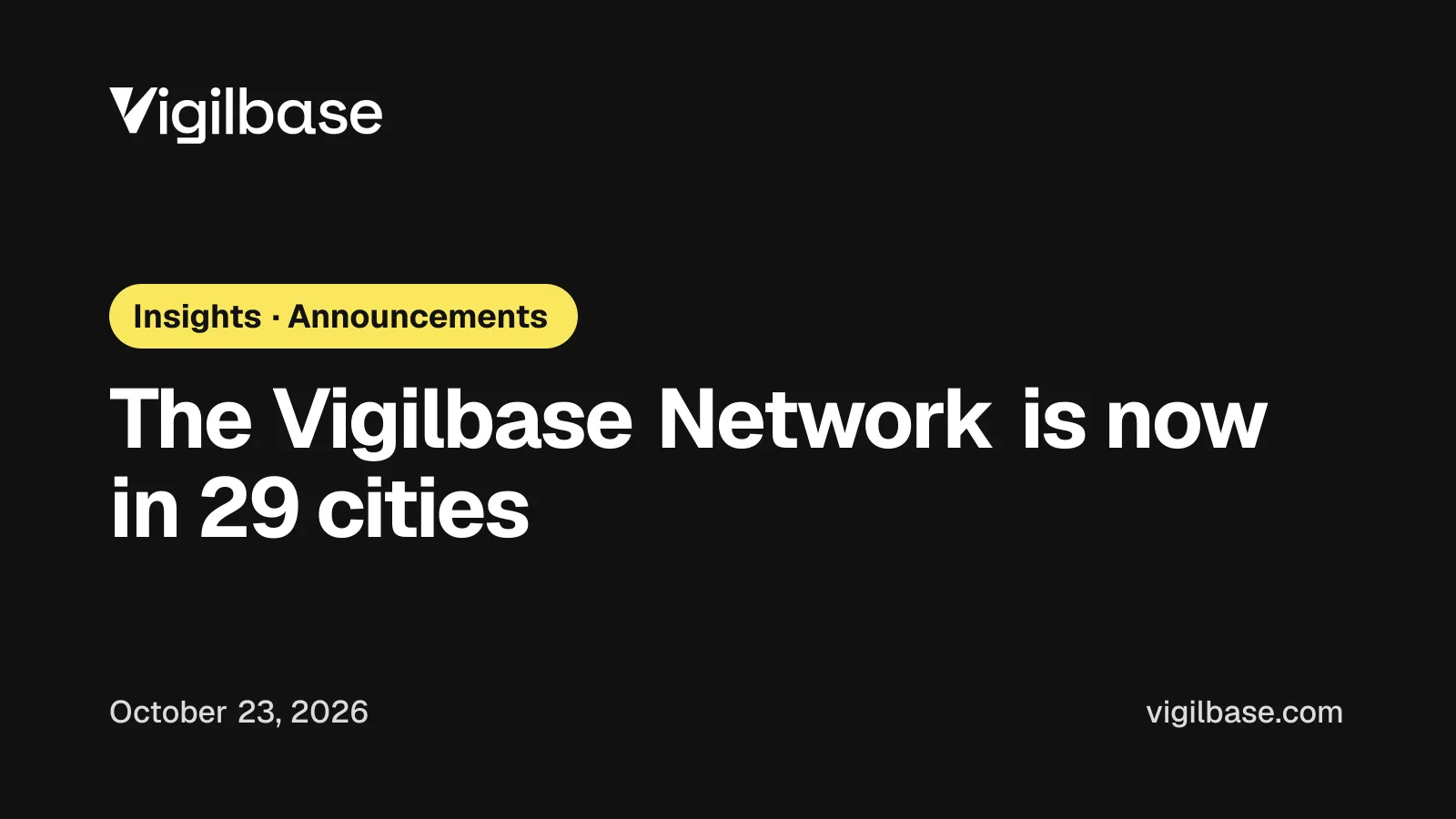
In June we started operating our own network, AS402630, from ten cities. As of 22 October 2026 it runs in 29.
The 19 new points of presence (PoPs) are Atlanta, Mumbai, Paris, Delhi NCR, Frankfurt, Honolulu, Seoul, Osaka, Los Angeles, Madrid, Manchester, Melbourne, Miami, Santiago, Seattle, Silicon Valley, Stockholm, Warsaw and Toronto. They join Bangalore, New York, Johannesburg, London, Mexico City, Tokyo, São Paulo, Singapore, Sydney and Tel Aviv.
Every PoP announces the same two address ranges: 198.135.109.0/24 for IPv4 and 2620:36:2000::/48 for IPv6. These are the only addresses our monitoring uses.
- PoPs
- 29
- Up from 10
- Continents
- 6
- Prefixes to allowlist
- 2
- One IPv4, one IPv6
Where the network is
| Region | PoPs |
|---|---|
| North America | Atlanta, Honolulu, Los Angeles, Mexico City, Miami, New York, Seattle, Silicon Valley, Toronto |
| Europe | Frankfurt, London, Madrid, Manchester, Paris, Stockholm, Warsaw |
| Asia | Bangalore, Delhi NCR, Mumbai, Osaka, Seoul, Singapore, Tel Aviv, Tokyo |
| Oceania | Melbourne, Sydney |
| South America | Santiago, São Paulo |
| Africa | Johannesburg |
The first ten cities gave us one PoP in most regions. The new ones fill in around them: Europe goes from one city to seven, India from one to three, Japan and Australia from one to two, North America gains the West Coast, Hawaii and Canada, and South America gains Santiago.
Monitoring from closer to your users
Watchdog, our uptime and security monitoring, now runs its checks from all 29 PoPs. You can monitor your sites from the cities your customers are in, rather than the nearest of ten, so the response times and outages you see are closer to what your users experience.
All of our monitoring now runs on our own network. The last check that still ran from a public cloud, in San Francisco, has moved to the new Silicon Valley PoP.
Two prefixes to allowlist
Every Watchdog check now comes from AS402630's own addresses. If your firewall, WAF or origin only accepts known addresses, allowlist these two prefixes:
198.135.109.0/24
2620:36:2000::/48
That list will not change when we add, move or replace a PoP. You can also read it at vigilbase.com/monitoring-ips.json.
How you reach the nearest PoP
The network uses anycast. Because all 29 PoPs announce the same addresses, the internet's routing sends you to the nearest one. Nearest means the shortest network path, which is usually, but not always, the closest city. With nearly three times as many PoPs, more people have one close by.
You can see which PoP answers you:
curl -s http://198.135.109.1/healthz ok vigilbase-network vigilbase-network-bom AS402630
The third word names the PoP that answered: here bom, Mumbai. Run the same command from a different network and you may get a different PoP.
What happens when a PoP has a problem
Each PoP keeps checking its own health. If something goes wrong, it takes itself out of service and traffic goes to the next nearest PoP automatically. Nobody has to change a DNS record, and when the PoP is healthy again it comes back into service.
More PoPs make that fallback better. When a city drops out, its neighbour is now often in the same country or region rather than on another continent.
See it for yourself
The live status of all 29 PoPs is public at vigilbase.net/status. Each PoP also runs our looking glass at vigilbase.net/lg, where you can run network diagnostics from any of the 29 cities.
We will keep adding cities where they bring the network closer to the people who use it. Subscribe to The Vigilbase Wire to hear about new PoPs and the services we build on top of them.